Tuesday, June 14, 2016

Stinging Nettle Soup


I found a gold mine of Stinging Nettles while on a bike ride that took me over sidewalks, across streets, past fields, and through the woods. In my case I was on a hunt for this delectable edible but it may trigger the newbie's sense of touch before their sense of sight. Both the oppositely arranged toothed leaves and the square stems are completely covered in stinging hairs that inject formic acid into skin that grazes it. How on Earth could such a plant be edible? With a snip, blanch, boil and blend.


To protect myself from the stinging hairs I used scissors to guide the top of the plant over my opened ziplock bag and snipped off the tender tips.


I filled up an entire 1-gallon bag.


Back home I carefully sifted through the nettles and remove debris.


I sauteed half of a chopped onion in 2tbs of butter, steamed a single carrot and a single potato, and blanched the nettles by giving them a 2 minute long boiling water bath (which disarms the stinging hairs).

I rinsed the blanched nettles.


I combined the nettles, sauteed onions, and steamed vegetables in a pot and brought them to a boil along with 3 cups of water and 2 bouillon cubes.

I placed soup in a blender...


and pureed the ingredients.

The result-a beautiful green and decadent soup!

Sunday, May 29, 2016

Black Locust, Robinia Pseudoacacia

Black Locust, Robinia Pseudoacacia
Sometimes you can experience a plant in single-sense doses before it reveals itself. I biked by your drooping white flower clusters and feathered leaves and wondered what you were. I took in your sweet grape-like aroma while I stood below you and tried to located where you were. In early spring I studied your bark, furrowed and armed with thorns but still you remained unknown to me. Today, I stood before you and all these senses were tantalized at once- the white drooping flowers, the thorny branches, and that sweet fragrance. Your identity was confirmed on page 184 of the Peterson Field Guide, "Black Locust, Robinia Pseudoacacia...leaves...with 6-20 leaflets...paired thorns at base of leafstalks...bark...deeply ridged...flowers white...in drooping clusters...very fragrant." Connections.

Robinia Pseudoacacia, Notice the Yellow Centers
According to plants.usda.gov, this plant is native to both Canada and the lower 48 states. It is also considered invasive in the state of Massachusetts. "A Guide to Invasive Plants in Massachusetts" explains that it is an excellent nectar producer and can outcompete native plant species for pollinators. This guide warns that the leaves, seeds, and bark are toxic.


I dug up my old foraging notebook and found, wild edible expert, Blanch Derby's instructions on how to make Black Locust fritters recorded on April 23rd, 2013. It has been three years since I watched her video, "Edible Plants Wild and Tame (Spring)," and today I was going to finally give this a go. The mosquitoes were all about this odiferous tree today and I squeezed my way in and indulged alongside them. I collected over a half-dozen flower clusters, all the while consumed by their intoxicating odor.


You'll need milk, eggs, and flour. Beat eggs and milk together. Heat a pan at medium heat until 2 tbs of butter is melted. Remove any leaves and debris from the flower clusters. Leave the stems long.


Dip each flower cluster in the egg mixture.


Then coat with flour.


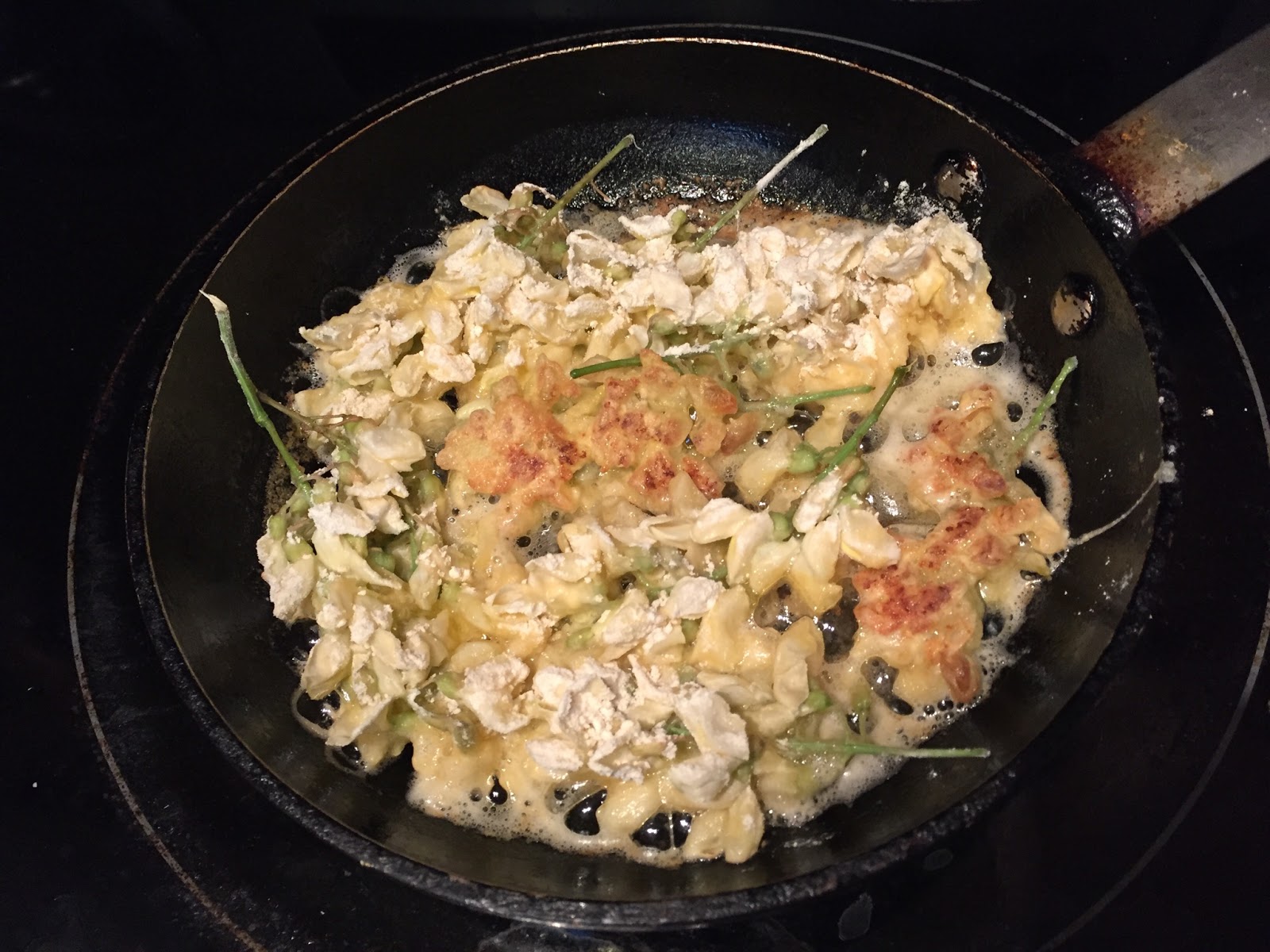
Place the coated flower clusters in the heated pan.


Fry each side for 3 minutes.


Spread fritters on a paper towel to cool.

Slack and I had a bite and thought they tasted great. We agree with the Peterson Field guide that the flower clusters make excellent fritters! I think sprinkling them with confectioners sugar would make them even better. Happy foraging!

Tuesday, May 10, 2016

Dwarf Ginseng; Curiosity Fed the Forager

Dwarf Ginseng, Panax trifolius

What I have learned is that foraging requires an individual with a curious mind. When you come across an unknown plant you have to ask, "what is this?" and then follow it up with a bit of research. I find myself noting the plants that I am familiar with in my head while I walk down the trail, garlic mustard...winter green...field garlic...violets... It's a good feeling to see familiar plants but what I search for are the plants that are unfamiliar to me. It is an amazing feeling to discover a new plant and, after flipping open your Peterson field guide, learn that what grows before you is edible. This happened to me on the last leg of my hike. I was heading back to my car when I noticed this small plant with a little ball of white flowers just above a whorl of three leaves each with three toothed leaflets. Once this one caught my attention I all of a sudden noticed them covering the ground all around me. It is at times like these that I wonder how I had never seen it before. 


When I first noticed this small plant I did not think it was edible but out of curiosity I leafed through my guide to the "white flower" section and to my surprise and delight I discovered that its little tuber is edible. It can be eaten raw or boiled for 5-10 minutes. It grows in moist woods and I just so happened to be about to cross a stream. It flowers from April to June. Apparently the only time to collect them is in the Spring so I was in luck.


After trying to pluck one plant from the ground I learned that the stem of Dwarf Ginseng is very delicate. In order to extract the plant I had to gently remove the dirt surrounding the plant until I got to the base of the root. I then had to pull up from the root and not the stem or the stem broke. The tuber looks like the World if the water was dried up. You can tell that the surface used to be connected but as the girth expanded the outer layer broke apart and formed fissures.


I was so excited to taste this trail nibble that I brushed off the dirt, gave it a quick spit shine, and took a bite. It was a bit crunchy and had a somewhat nutty flavor. It was pleasant. I confirmed on the USDA plant database website that this plant is native to North America, it is a perennial, and it is neither endangered nor invasive. Happy foraging!